 The Drape Review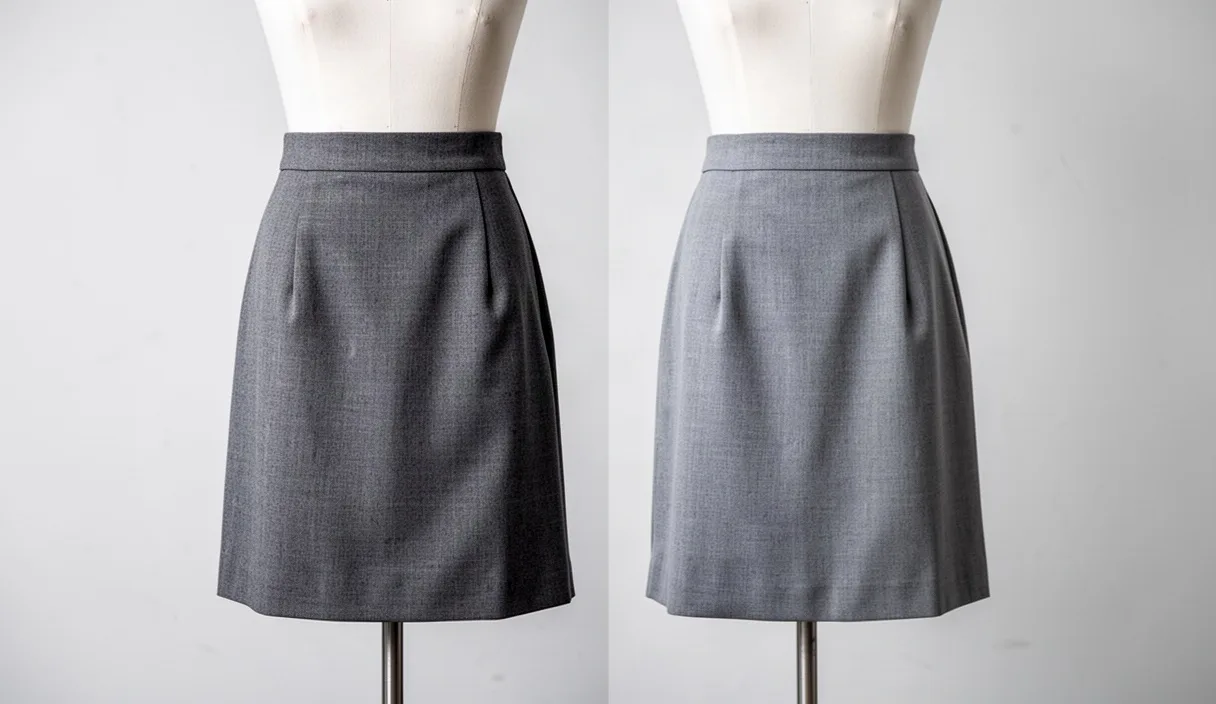
Two skirt silhouettes dominate most working wardrobes: the A-line and the pencil. Both are defined by how the hem relates to the hip measurement, but the construction logic behind each one produces different results on different bodies. Choosing between them is not a matter of fashion preference alone, it is a question of how fabric moves relative to the waist-hip differential, the fullness allowance at the hem, and the activity the garment needs to accommodate.
This article defines each silhouette by its pattern construction, explains how hip-to-waist ratio changes the fit outcome, and covers fabric weight, styling by occasion, common fit problems, and movement requirements. The goal is a practical reference, not a styling opinion piece. Measurements and ratios referenced below are general guidelines; a tailor or pattern-maker should be consulted for a garment that will be altered or custom-fitted.
Defining the A-Line Silhouette
An A-line skirt is cut so the hem circumference is measurably wider than the hip circumference, typically by 8 to 20 inches depending on the flare intensity. The seam lines run from a fitted or semi-fitted waist outward in a straight or slightly curved diagonal, producing the triangular "A" shape the name describes. There is no fitted dart structure through the lower hip in most A-line patterns; instead, the flare absorbs the volume that would otherwise require shaping.
Three sub-types exist within this category, and they behave differently on the body:
- Full A-line: hem flare exceeding 15 inches beyond hip circumference, often using gores (multiple fabric panels) to add width without bulk at the seam.
- Modified A-line: hem flare between 8 and 14 inches, the most common ready-to-wear version, usually cut from two or four panels.
- Gored A-line: six or eight panels, which allows the flare to be distributed evenly and reduces the "tent" effect that a two-panel A-line can create on fuller fabric.
Because the flare begins at or below the hip point, the A-line does not rely on the hip measurement for fit accuracy the way a fitted skirt does. A pattern cut for a 38-inch hip will still hang reasonably on a 40-inch hip if the waist is correctly fitted, since the extra 2 inches is absorbed into the flare rather than straining a seam.
Defining the Pencil Silhouette
A pencil skirt is cut with a hem circumference equal to or narrower than the hip circumference, commonly 2 to 6 inches narrower, which is why most pencil skirts include a center-back or side vent of 3 to 7 inches to permit walking. The waist-to-hip transition is shaped with darts, princess seams, or a combination of both, meaning the garment follows the body's curve rather than flaring away from it.
Fit tolerance on a pencil skirt is narrow. A difference of even 1.5 inches between the pattern's intended hip measurement and the wearer's actual hip measurement will show as either pulling (too tight) or excess fabric folding at the hip crest (too loose). This is the structural trade-off: the silhouette that shows the body's line most precisely is also the one with the least forgiveness for measurement error.
Length matters more here than in an A-line. A pencil skirt ending above the knee shortens the visual line of the leg less than one ending at mid-calf, because the narrow hem restricts stride length and calls attention to the vent opening. Most ready-to-wear pencil skirts fall between 20 and 24 inches from waist to hem for this reason.
How Each Silhouette Interacts with Hip-to-Waist Ratio
Hip-to-waist ratio is calculated by dividing the hip measurement by the waist measurement. A ratio above 1.25 indicates a pronounced waist definition relative to the hip; a ratio closer to 1.0 to 1.1 indicates a straighter, less-defined transition between waist and hip.
The two silhouettes respond to this ratio in opposite ways:
| Hip-to-waist ratio | A-line result | Pencil result |
|---|---|---|
| 1.0 to 1.1 (minimal waist definition) | Creates a defined waist visually through the flare contrast; generally a reliable choice. | Requires accurate waist shaping via darts; without it, the skirt reads as a straight tube with no waist indication. |
| 1.15 to 1.25 (moderate definition) | Flare begins close to the natural hip curve; fit is comfortable with minimal alteration. | Fits well off-the-rack in most cases since this ratio matches standard pattern grading. |
| Above 1.25 (pronounced definition) | Flare may start too high or too low relative to the hip crest, requiring a shortened or lengthened waist-to-flare point. | Darts must be deeper or more numerous to follow the curve; standard two-dart patterns may gap at the waistband. |
In practical terms, a ratio above 1.25 is the scenario where off-the-rack pencil skirts most frequently need a side-seam or waistband adjustment, because most commercial grading assumes a ratio closer to 1.15 to 1.2. An A-line at this ratio usually needs no alteration beyond waist circumference, since the flare does not need to track the hip curve precisely.
Fabric Weight and Its Effect on Drape
Fabric weight changes how each silhouette reads on the body, sometimes more than the cut itself does. A-line skirts in lightweight fabric (under 150 grams per square meter, such as cotton voile or light crepe) will flare with visible movement and can appear to add volume at the hem with each step. The same pattern in a mid-weight wool (260 to 320 grams per square meter) will hold a cleaner, more architectural line because the fabric has enough body to resist collapsing into soft folds.
Pencil skirts behave differently. A lightweight fabric on a pencil cut will cling and show every undergarment line and body contour, which is why most pencil skirts are made from fabrics in the 220 to 300 grams per square meter range, often with 2 to 4 percent elastane added for recovery. Without stretch, a heavier fabric (above 320 grams per square meter) on a pencil skirt can restrict stride and cause the vent to gape open while walking.
A practical fabric-selection rule: if the fabric drapes in soft folds when held up and released (test by draping 12 inches of fabric over your hand), it suits an A-line better. If it holds a flat plane with minimal folding, it suits a pencil cut better. Fabrics with a stiff hand, such as unlined tweed or heavy twill, can work for either silhouette but will require more precise seam finishing on a pencil skirt to avoid a boxy appearance at the hip.
Styling Each Skirt for Different Occasions
For office or business-formal settings, a pencil skirt in a mid-weight fabric paired with a structured blazer that ends at or just below the hip bone maintains a continuous vertical line. An A-line in the same setting works best in a solid color or small-scale print, kept to knee length or just above, since longer A-line hems can read as more casual or bohemian depending on fabric choice.
For semi-formal or evening occasions, fabric choice carries more weight than cut. A pencil skirt in satin or a silk blend creates a fitted evening look, but satin's sheen will highlight any hip-area pulling, so accurate sizing matters more here than in matte fabrics. An A-line in a fuller, gored construction using taffeta or a structured crepe can serve as an alternative to a fitted dress for evening wear.
For casual settings, both silhouettes adapt easily:
- A-line in cotton or linen, paired with a simple t-shirt and flat sandals, for warm-weather daywear.
- Pencil skirt in a stretch-denim or ponte knit, paired with a loose knit top to offset the fitted lower half.
- Either silhouette in a midi length (roughly 28 to 32 inches from waist) works for transitional-season dressing with boots.
For maternity or postpartum dressing, an A-line with an elasticated or wrap waistband accommodates changing measurements without alteration, whereas a pencil skirt generally requires a maternity-specific pattern with an expandable panel; a fitting consultation is advisable if comfort or support is a concern.
Common Fit Issues and Fixes
The most frequent pencil skirt problem is horizontal pulling across the high hip, roughly 3 to 4 inches below the waistband. This indicates the hip measurement used for the pattern or size selection was smaller than the wearer's actual hip measurement. The fix is sizing up through the hip only, which a tailor can do by letting out the side seams if at least 0.5 inch of seam allowance exists on each side.
The second common issue is waistband gapping on a pencil skirt with a defined waist, caused by darts that are too shallow for the waist-to-hip differential. Deepening the existing darts by 0.25 to 0.5 inch each, or adding a third dart, generally resolves this without needing to resize the entire garment.
For A-line skirts, the common issue is the flare starting too high, which can add visual width at the hip rather than minimizing it. This happens when the flare point is positioned at or above the natural waist rather than at the high hip. The fix usually requires repositioning the side seam break point, which is a pattern alteration rather than a simple seam adjustment, so it often needs a tailor rather than a DIY fix.
A third issue affecting both silhouettes is hem unevenness after alteration, particularly common when shortening a gored A-line, since each panel must be trimmed proportionally to maintain the flare's symmetry. Marking the new hemline with the garment on the body, using a hem gauge or a second person, reduces this risk.
Choosing Based on Movement Needs
Stride length is the deciding factor for anyone who walks long distances, uses stairs frequently, or needs to sit and stand repeatedly during the day. A pencil skirt restricts stride to roughly 12 to 16 inches without strain, even with a vent, whereas an A-line permits a near-normal stride of 20 to 24 inches due to the added hem circumference.
For roles involving physical movement such as teaching, retail floor work, or frequent travel, an A-line or a pencil skirt with a vent of at least 6 inches and some added stretch (2 percent elastane minimum) is more practical than a non-stretch pencil skirt. For desk-based or seated roles, the pencil skirt's movement restriction is less relevant, and the fit precision becomes the priority instead.
Cycling, climbing stairs quickly, or any activity requiring a wide stance is generally incompatible with a standard pencil skirt regardless of vent depth; an A-line or a skirt with a center pleat is the more functional choice in these cases.
Common Mistakes
Buying a pencil skirt based on waist measurement alone, without checking the hip-to-waist ratio against the brand's size chart, is the most frequent cause of a poor fit. Another mistake is choosing a lightweight, non-structured fabric for a full A-line, which can make the hem look limp rather than architectural. A third mistake is ignoring vent depth on a pencil skirt purchased for a job involving regular walking or stair use, which leads to seam strain or tearing over time.
Next Steps
Measure the waist, high hip (3 to 4 inches below the natural waist), and full hip before comparing against any brand's specific size chart, since grading varies between manufacturers even within the same silhouette category. If a pencil skirt pulls at the hip or an A-line flares awkwardly at the seam, a local tailor can usually assess whether the issue is a sizing error or a pattern-fit issue specific to that body's proportions, and can advise whether alteration is cost-effective relative to buying a different size or brand.